Buttons, and Balance - Discussion
Dear friends,
I want to to bring up some thoughts in this thread on design philosophy, and be a bit critical. If I may. It should go without saying that the Intrepid team is, as ever, doing fine work. It's meat and potatoes time. No veggies. It's worth saying up front, as well, that I do not intend to portray my thoughts, collected here, as though you ought to share them. I only mean to state clearly what I think, and make a case for why I think it. Call me a fool or toss a dollar in the tin, as you please; the real hope is that the developers will get some value out of seeing the discussion. Mine’s a cynical perspective, sure, but that’s my disposition, so that’s what I intend to offer.
.
In Defense of Buttons.
In the last ten years or so, there has been a push for video games at-large toward what we can call “minimalism.” Not just MMOs, although I first noticed this trend being consolidated in MMOs—for reasons I’ll discuss in a moment. Elder Scrolls Online was the earliest I can recall where the studio chose to market this as a design philosophy, and as a selling point of the game. The idea was that having less ‘stuff’ on your screen meant you had more real-estate to look at the world, and therefore, that less stuff meant more immersion. We heard this a lot. Some players were excited by this line of reasoning; look how pretty. I was not. You’ll notice perhaps, like I did, that the argument very carefully conflates a minimalist aesthetic, with a minimal amount of actual gameplay mechanics. The reality of the situation was, that every class only had a bar of about five active abilities. You had your four buttons, and your ‘ultimate.’ I think this fashion was the result of two major factors.
The first was a general desire that cropped up back then (2011 or so, perhaps a bit earlier), to try and press the waning MMO format into the more popular space of MOBAs, mostly because they sold better. WoW was plateauing and losing subs for the first time in a long time. Several “WoW killers” had consumed massive budgets and flopped entirely. DoTA 2, and League of Legends were exploding. Corporate ear-pieces were trying to force their existing products to appeal to those markets. Good businessmen also demanded cross-console marketability for everything, which, meant that games had to have interfaces that were simple enough to be easily mapped onto a console controller. That created an environment where it became, understandably although regrettably, fashionable to reduce, reduce, reduce. What I’m talking about here, however, is a much larger subject—and one into the details of which perhaps I’ll go in a different thread—so, let's stick just to the issue of class depth in the form of buttons.
Most RPGs out there have, for years now and for a slew of reasons, taken it for granted that you get only a handful of actionable abilities. The second thing that fell into place, is that the prejudice for minimalism allowed the studio to explain away as ‘immersive’ what was essentially a bare-bones approach to actual class depth. It’s clever, but still made for a bad, shallow game. Guild Wars 2 provided a similar feeling in terms of curtailed combat. You had your five buttons. You press the single target button when its single target. You press the template attack button when there's a few targets. You press the heal button when you’re damaged. You press your big boy button when its time to make some big boy noise. That’s it. Of course, over time, Retail WoW became something similar. Every class was pared back to have a few ‘resource builder’ abilities, and a few ‘resource spender’ abilities. Every class got some way to self-heal. They all gradually began to more-or-less play the same, and feel the same. Build, build, spend. Build, build, build, spend.
Boring, boring, boring. No soul.
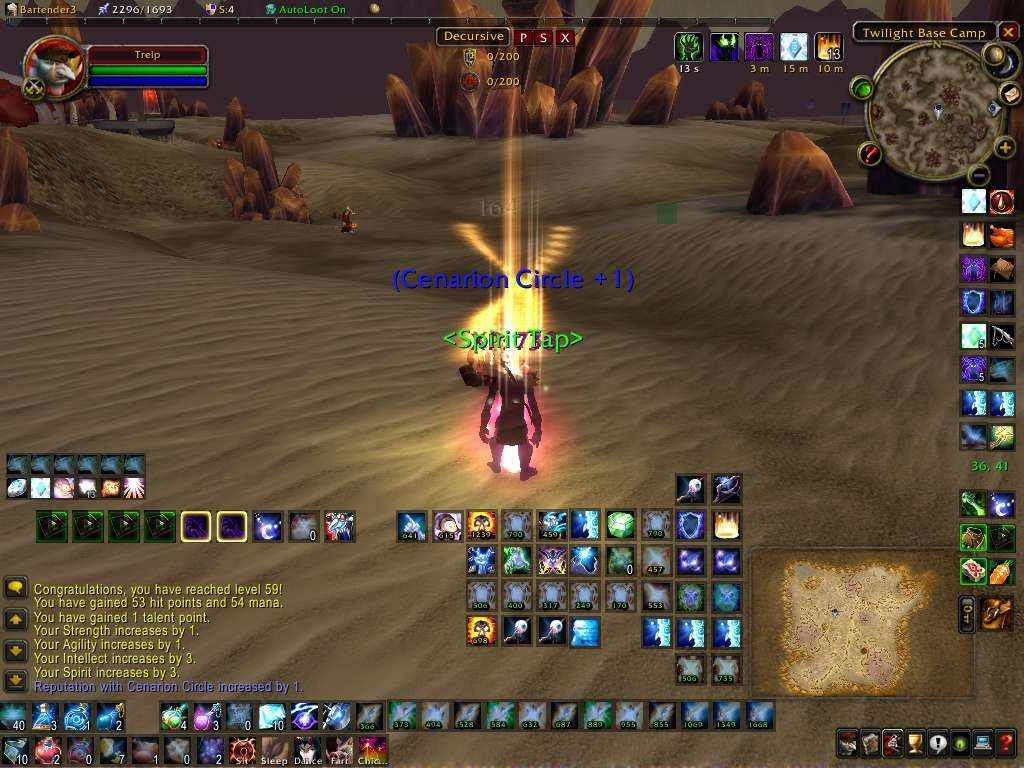
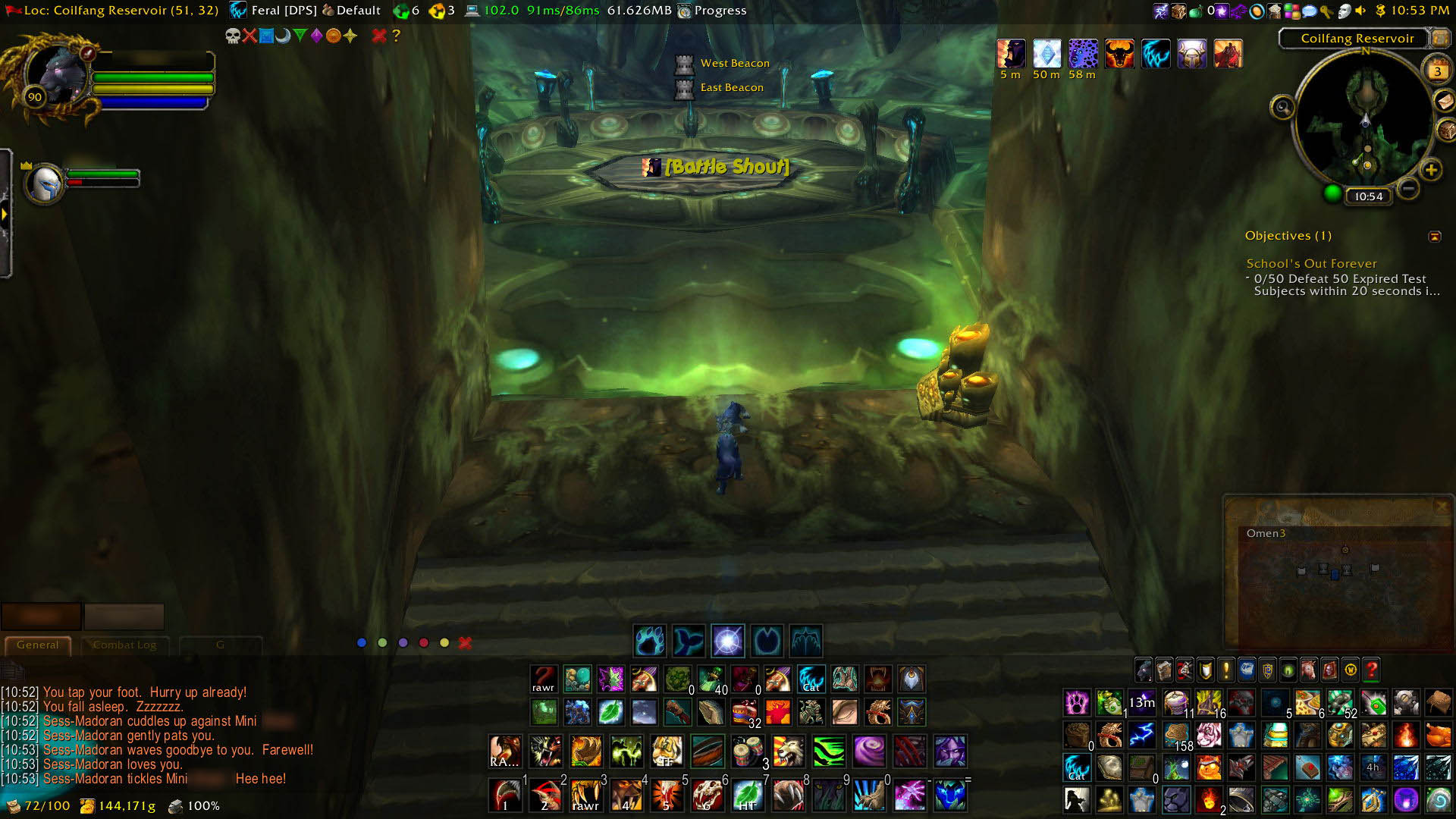
The main point I want to make is this: "Minimalism," so-called, does not equal immersion. As a matter of fact it’s the opposite. In old-school MMOs--take vanilla WoW, for example--a lot of players balk at the amount of buttons on the screen. Modern developers as well. How can fifty things on the screen possibly be immersive? Well... it’s not so much of a puzzle. In the early game, you have maybe five. As you progress, you accrue more, and more. Leveling up your character isn’t just a number on the character sheet, and floating combat numbers. It’s more thingsto get the hang-of. It’s actual, literal progression in the form of learning skills, not just abstract progression in the form of xp or numbers applied to a tooltip.
They’re not all combat abilities, they’re not all part of your rotation. Some are niche, some are out of combat utility. Some are crowd control. Some are lateral options, that make sense in one scenario, whereas others make sense in a different scenario. Some might get cooldowns that modify certain types of spells. Do I “quicken” my heal to an instant cast, or quicken my crowd control? Or do I quicken my fireball? Decisions, decisions. A huge component of this are utility spells. More than half the things on my bars in the old days were non-combat abilities. They were things that only my class could do, that provided utility to other players, or provided some kind of flavor. That made my class feel different. Travel forms, teleports, conjurations, pet taming, buffs, debuffs, enchantments, mind control, tracking, far-sight..
The end result being that by the time you hit cap level, you had become a master of your class. When I was a kid, I can recall playing a low-level hunter in WoW. I had my five buttons, and one afternoon I went over to a friend’s house to watch him raid Molten Core. There were buttons all over his screen. It was the coolest thing I’d ever seen. He wasn't just playing the DPS meter either. He was kiting adds, and controlling problems, managing complex positioning, dispelling the boss’s engrages, and managing his mana bar and his pet. He was an integral component of this massive group of players, and had to perform tasks that only his class could perform. I wanted to learn how to play like he played. I wanted to get better at my class, and see what all those abilities were, and learn how to use them all. I wanted to be a better hunter, and that’s immersion. Said another way, I wanted to play the game. That’s soul.
When you give me an action bar of only five active abilities, and a big-boy button, I feel like I’m playing a mobile game. So, I go back to bootleg private servers for 30-year-old MMOs, because they treat players like human beings who have the capacity to master a skillset. Not like buffoons who can’t fathom the idea of down-ranking a spell.
.
On the Myth of Balance
Balance, balance, balance. Whatever the meta is, we hate the meta. Balance the meta, the meta is the meta, on account of bad balance. Yes, yes. Alright I’ll cut to the chase. Balance, in the way that most players seem to apply the term, is a myth in my mind. Read between the lines of much of the talk on the subject of balance in MMOs, and you’ll find people essentially describing their desire to have all classes play the same, have the same access to the same effects, and no specialties. ‘Anyone who can do something that I can’t, is unfair.’ Or, ‘Any situation where I’ve been pushed into a corner is unfair.’
What do you do? Remove all corners from the game, so no one gets pushed into them? Remove all specialties from the game so that no one has something I don’t? It's always about removing something seen as unfair, never about adding something to make the dominant strategy maybe more of a lateral strategy. Most players wouldn’t even agree that that’s what they’re doing—or realize that it’s the implication of the common attitude—but nevertheless, it’s a matter of fact. So much for the dangers of listening to the community too much. So what is balance, then? Balance, I think after a decade or two of reflection, is something I will try to describe as a function of two variables. The first is horizontal—or width. The second, is a sense of cost—or sacrifice. Very poetic, I know. Look here.
Width, or horizontal utility, is something that I believe Steven’s talked about, many times, in his own way on the dev streams. I’m hopeful about Intrepid’s design philosophy on this point. Width is generally a player’s ability to make multiple reasonable choices in a given scenario. If you play Magic: The Gathering like me, you can think of this like what we call 'lines-of-play,' at any given board state. If you don't, humor me a moment.
Magic players often talk about ‘playing to their outs.’ In lieu of a long-winded explanation: Playing to your outs means using what cards you have, and a degree of game-knowledge, to create scenarios on-board where the number of ‘bad’ draws from your deck are minimized. Good players constantly fight to keep the board in a position, where their deck is most likely to provide them something useful. In other words, bad magic players blame their deck, good magic players assume responsibility for their deck.
Often times there are numerous lines-of-play to negotiate. The skill ceiling can get quite high. There are horizontal options. Forks in the road. Risk, and reward. A number of ways to play it. A number of ways to win and feel smart, and a number of ways to lose and reflect on whether or not you did the most you could, with what you had available. Most times, you didn’t. Most times you learn. That’s what keeps me coming back to a game for twenty years, as opposed to logging out after twenty minutes and sitting in the shower, with the lights out thinking about how I don’t particularly want to go to work tomorrow. That’s width.
Cost, or sacrifice, is the idea that in order to gain some effect that puts you in a position over-top of someone, you have to expose a weakness to them. Scientific types call it entropy, that things fall apart without some injection of will. Literary types call it other pretty things. If you're into those funny black and white backwards-comics, its equivalent exchange. But the general principle is this: To get something, you have to give something first. This is true of good games, good writing, good craftsmanship, it’s true of anything good or lasting in life. And the result of wishing it away is atrophy.
If the rogue is going to have access to three stuns that lock me down for six seconds, he had better be a glass cannon. That way, when I use a cooldown the break the third stun--god willing I get a crit (which is likely, because I am stacking crit, at the cost of a larger health pool)--he folds like a napkin. Some players would not have taken the risk of stacking crit in this scenario, and they would die. Or maybe their health pool would be larger, and they’d get another hit. But they don't hit hard enough. So they die. Both players might be mad and complain. Take the stuns away, they’re unfair. It’s unbalanced.
For my part however, with youth having fled from me, now, like a good dream, I see the situation a bit differently. I see that had the gods blown the wind the other way and tipped my dice, it would have been the rogue with his shorts down, and I can see that I built my character so as to make that favorable wind particularly likely. I had options, provided to me by the game, to configure a little contraption of circumstance to counter the rogue, and I did so. I was playing to some of my outs. And that feels good. It feels like I’ll get him next time. Actually it feels like I hope he’s camping me so I can jump him and return the favor. It feels like I want to keep playing. And on a bit more reflection, perhaps it occurs to me as well that I forgot to slonk my evasion potion, because I was surprised. Had I gulped that, I might have gotten another roll at the crit. That’s something for me to keep in mind. It’s a way to grow; its tools I am hanging on my toolbelt and slowly learning to manage with my other tools. It’s a line of play I didn’t see. And that's cost.
So for the devs: Bring options to the table, and be smart about which options you bring, and to which tables. But the proper answer to some meta is more options, and more tables, so that the "right" option isn't always so clear, or definitive. Go broad. Get scrappy.
.
Buttons and Balance
Both of these ideas, about buttons and about balance, I’m sure you can see go hand-in-hand. I think that Steven’s talked about rock-paper-scissors several times in the past, and it sounds a lot like what I’m describing here in terms of cost and sacrifice. Rock slams scissors, but at the cost of being weak to paper. This is good balance. If you’re rock and you keep getting plastered by paper, make friends with scissors, or, go pick up the scissors professions. Develop your character. Make some sacrifices. Play to your strengths, and work with your flaws--instead of trying to be flawless. Flawlessness means indistinguishability. Balance means too many options and circumstances to determine the optimal line for all scenarios. And then the real magic occurs: Rock with scissors in his pocket now has a fascinating matchup against rock with paper in his pocket.
If your classes don’t have flaws, and if they don't have a dozen janky ways to account for them, I’m going back to my bootleg MMOs with buttons all over the screen to mess around with some janky build I haven’t tried before. Bear with me just a tick. Emil Cioran wrote, in discussing the idea of utopia, or for our purposes, in discussing the idea of some mythical “fair” game, where no one has one-up on anyone, ever--he wrote that “A child who does not steal is not a child.” Point being, the soul is in the cost, and the width.
.
Assessing Ashes
In a recent dev stream, Steven and Margaret also described that the average number of active abilites for a given class will be somewhere between thirty-five and forty. If that’s true, I’m beside myself. It’s been decades since a video game had the balls to give me a spellbook full of buttons to figure out.
It also seems like weapons have skill trees, which are tuned around passives and procs, as opposed to providing active abilities themselves. This also, if I understand correctly, seems very good to my eye. However, I’ll voice one concern. Perhaps someone can tell me if this has been addressed in a video I haven’t seen. In the ranger dev stream, Steven and the developers described how one weapon might synergize with a class ability, whereas a different weapon might synergize with a different class ability. On paper this sounds like interesting width, however, I can also forsee a situation where, using a shortbow to get one synergy means foregoing the class ability that synergizes with a different weapon. So, while its true I have “access” to thirty five abilities, in practice, when I choose my weapon, I am choosing to render some of them useless.
If that’s the case, I worry about creeping back toward the unhallowed ‘five-button-bar,’ which so obviously and admittedly haunts me in the small hours of the morning, like a disapproving look from my disappointed father.
Elder Scrolls Online provides another cautionary example for this concern. It was marketed as having huge width, because your weapons gave you access to skill lines outside of your class. The unfortunate reality, however, was that all weapons had the same four-or-so abilities available. Morphing one didn't give you an additional ability, it consumed and replaced one. And further, you only had the ever-present five-button-bar anyway, into which to slot your abilities. So, while its true that a class has the potential for forty abilities, a mage with a staff and a cleric with a staff are both seeing the same pool of staff abilities. It’s really twenty. And then, you pick maybe one from your staff, add it to your bar, and that’s that. Suddenly forty abilities is really five buttons; anyone with a staff equipped had the same one or two abilities equipped. A boring shame.
I think at this point I run the risk of rambling, so I’ll leave it here. Presuming it goes without saying that Steven and the Intrepid team are a gasping breath of fresh air, in an industry up to it’s neck like Tantalus in the stagnant water of ‘just good business.’
Direct your tomatoes below, if you would.
Yours, brashly
Luthric