I would like to preface this by saying that I am new here. I have been following Ashes of Creation for a few years, but only recently have I decided to take a more active role in supporting the game and the developers.
I feel like I speak for many when I say that the original developer pitch of an 8x8 class system with effectively 64 class combinations was one of the things that first attracted my attention to Ashes of Creation. In a systems based RPG there is no system more integral to game play and user experience than the class system. A commitment to fully fleshed out multi-class combinations with unique and flavorful skills, spells, and abilities is a bold undertaking, but it also has the potential to deliver a truly great MMORPG experience.
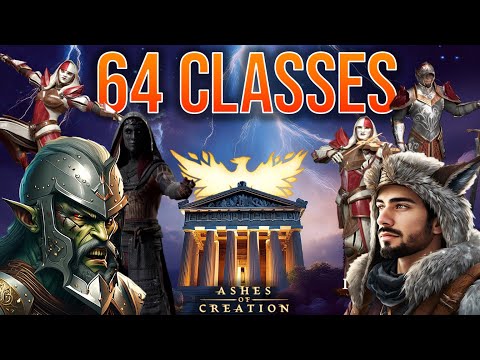 https://www.youtube.com/watch?v=Nle0WV2J-64
This video has made me start to think long and hard about what it is players expect from the 8x8 Class System and whether or not the Augment system really delivers the experience players are looking for. It seems clear to me that the allure of such a system comes from the customization and uniqueness that the individual multi-class options offer players. A player who is excited to be a Paladin is not going to be satisfied by a Tank that has Cleric themed abilities. Their expectation is that combining Tank and Cleric yields an entirely unique class. The unique and flavorful names given to each of the class combinations reinforces the idea that they will stand out as unique and flavorful classes that have their OWN unique abilities.
The community seems to realize that their expectations for the system far exceed the design space that is currently being discussed and the general trend seems to be a tempering of excitement and expectations in anticipation of a disappointing conclusion either in the form a reduction in the overall number of classes or in the watering down of the distinctness and power of each class. I would like to suggest that the original concept of an expansive multi-class system with unique and flavorful multi-classes is not only still within reach, but that the template for creating such a system has been around for decades.
Dragon Warrior VII is a game which came out in 2000 for the original Playstation and which has one of the best templates for a multi-class system I have ever encountered in an RPG.
https://archive.org/details/dragonwarriorviiprimasofficialstrategyguide2001/page/n7/mode/2up
In this system character level and class level are decoupled from each other. A character can go to the class temple and become one of 10 different base classes such as Cleric, Fighter, or Mage. When a player selects a base class for one of their characters it provides a base attribute modifier. A Fighter for example gets STR: No Change/AGI +15%/GRD (guard) -10%/INT -30%/HP - No Change/MP -50%. As they level up in Fighter, they gain fighter abilities along the way with the class defining abilities often coming early in progression and a powerful specialized abilities coming later. A player can change their class at any time, but they retain any skills or abilities they earned along the way. If a player obtains max level as a fighter they learn Windbeast, a powerful single target skill that costs no MP. If the character then changes their class to become a Cleric, they will lose the Fighter attribute modifiers and gain the Cleric modifiers (-20% STR, -10%Agi, +10%INT, +30% MP etc) however they will still know Windbeast along with any other spells/skills they earned along the way. Once a player obtains max level as a Cleric and knows all of the Cleric and Fighter skills they have to option to train as a Paladin which has its own set of much better stat modifiers (+10% STR/+15% AGI/+15% INT and no negatives to any other stats) and a new list of skills and abilities to learn that are completely unique to Paladin. In this way the class system becomes additive with players spending time learning to play each of base classes individually before they dive into the more diverse and challenging advanced classes. By keeping the number of abilities each class obtains relatively small (8-10 abilities per class), but making them exceptionally unique and flavorful it allows the number of tools in the characters toolkit to grow steadily as they progress without overwhelming the player with too many choices. The balance comes from the stat modifiers. While a Fighter who previously trained as a Cleric may have powerful heals in his spellbook, he can only cast one or two of them before his -50% mana pool runs out. Conversely a Cleric who previously trained as a Fighter has access to the powerful Windbeast attack , but its damage will be limited by the Clerics -20% strength modifier. However once a player has mastered both Cleric and Fighter and assumed the role of Paladin they suddenly find they have the right modifiers to use ALL of their skills in conjunction while also gaining powerful Paladin only abilities like Magic Wall which is the only ability in the game that reduces incoming Magic Damage to the entire party.
Obviously such a system would need modifications in order to adapt it from a Single Player RPG to an MMORPG, but ultimately the core system seems like a much BETTER fit for for Ashes of Creation than the Augment system being discussed right now. Furthermore, while the idea of 64 unique classes is tempting I think most players would be happy to compromise on the NUMBER of unique classes at launch in exchange for better EXECUTION of the ones we have. Certain class combinations are much stronger thematically than others and I would like to see 24 class combinations that are done WELL than 64 class combinations that are watered down and samey.